Renault 4 / 4L: history, engineering & rental in Groningen
Jan 4, 2026 • 23 minutes reading time
Renault 4: history, engineering, versions & tips
Renault 4: Complete Guide + Rent a Renault 4 in Groningen
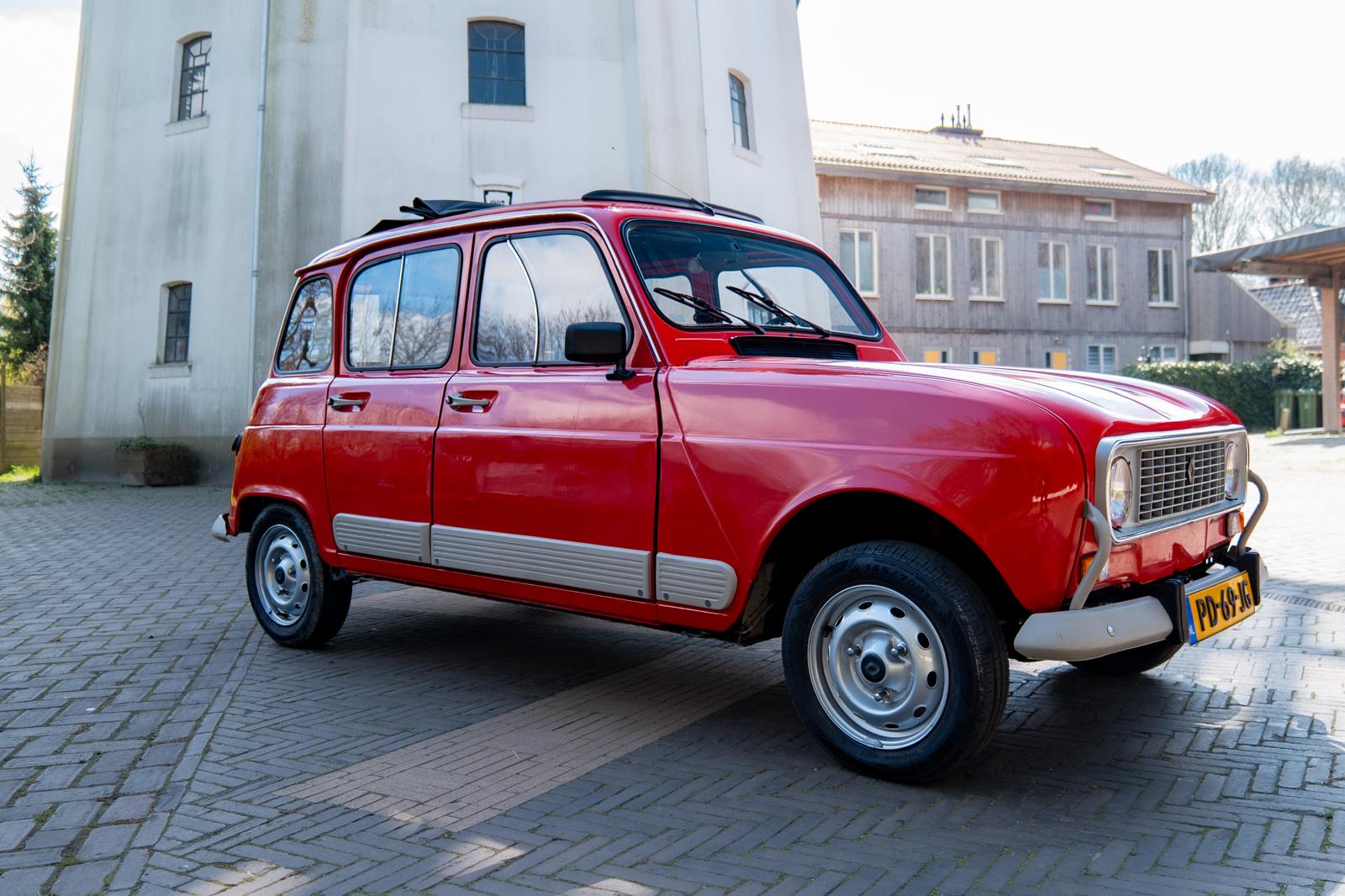
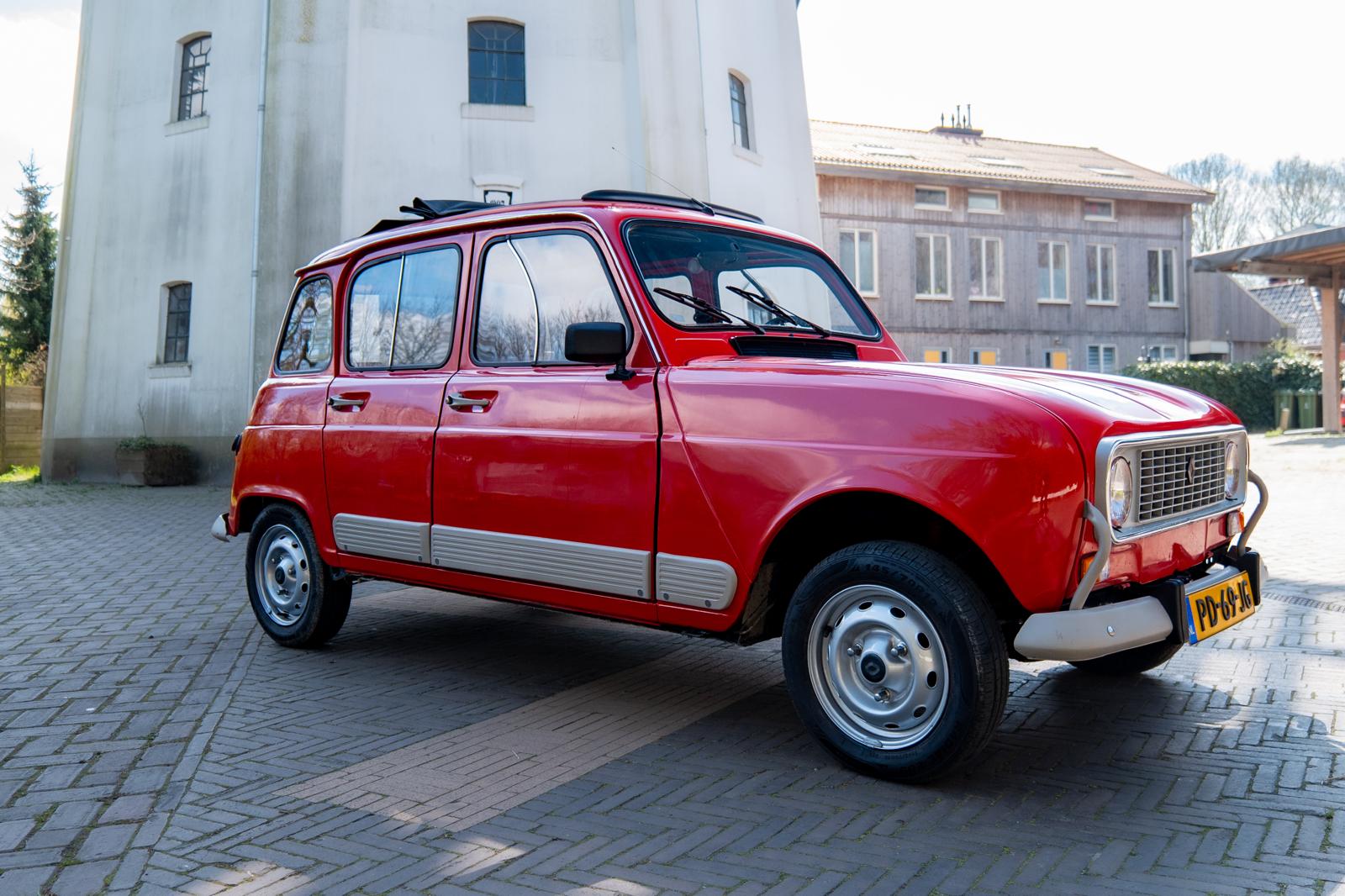
When you see a classic Renault 4 parked next to a modern Fiat 500, it’s hard to imagine just how much space the Renault 4 actually offers. Robust, roomy, and affordable. That’s why, until about 30 years ago, you could find the Renault 4 on almost every street corner. Many parents of today’s forty- and fifty-somethings owned one for a long time as their family car. The Renault 4 is without a doubt one of the greatest icons in automotive history. With more than 8 million examples built (1961–1992, with continued production until 1994), spread across many countries, the “Quatrelle” (or “4L”) was far more than a cheap small car. It was a social phenomenon, a workhorse, a symbol of freedom, and one of the first mass-produced hatchbacks. Want to experience that feeling again, or take your father or mother on a ride down memory lane in this classic? You can rent the Renault 4 classic in Groningen at Tonny’s Classic Drive. You might also like to view the entire classic fleet. We have the Renault 4 in three colors and all three have a large open roof; you can open and close it very easily with one hand movement. This way, as driver, passenger, and also on the back seat, you can enjoy the sunshine and fresh air when you rent a car. We have beautiful routes we can provide so you’ll pass unique spots in Groningen. Follow our YouTube channel for more videos about Renault 4 rental.
Why the Renault 4 is special
The Renault 4 bridged social classes in a way few other cars ever have. From workers to intellectuals, from farmers to city dwellers—everyone found something in it. This universality did not happen by accident; it was the goal from the start, set by managing director Pierre Dreyfus. In this article:
- Why the R4 became the first people’s hatchback and how Pierre Dreyfus’ “blue-jeans philosophy” changed the car industry;
- Which version fits best: TL for authenticity, GTL for longer drives, or one of the rare variants;
- What you notice while driving: from the dashboard gear lever to the driving experience on Northern Dutch roads.
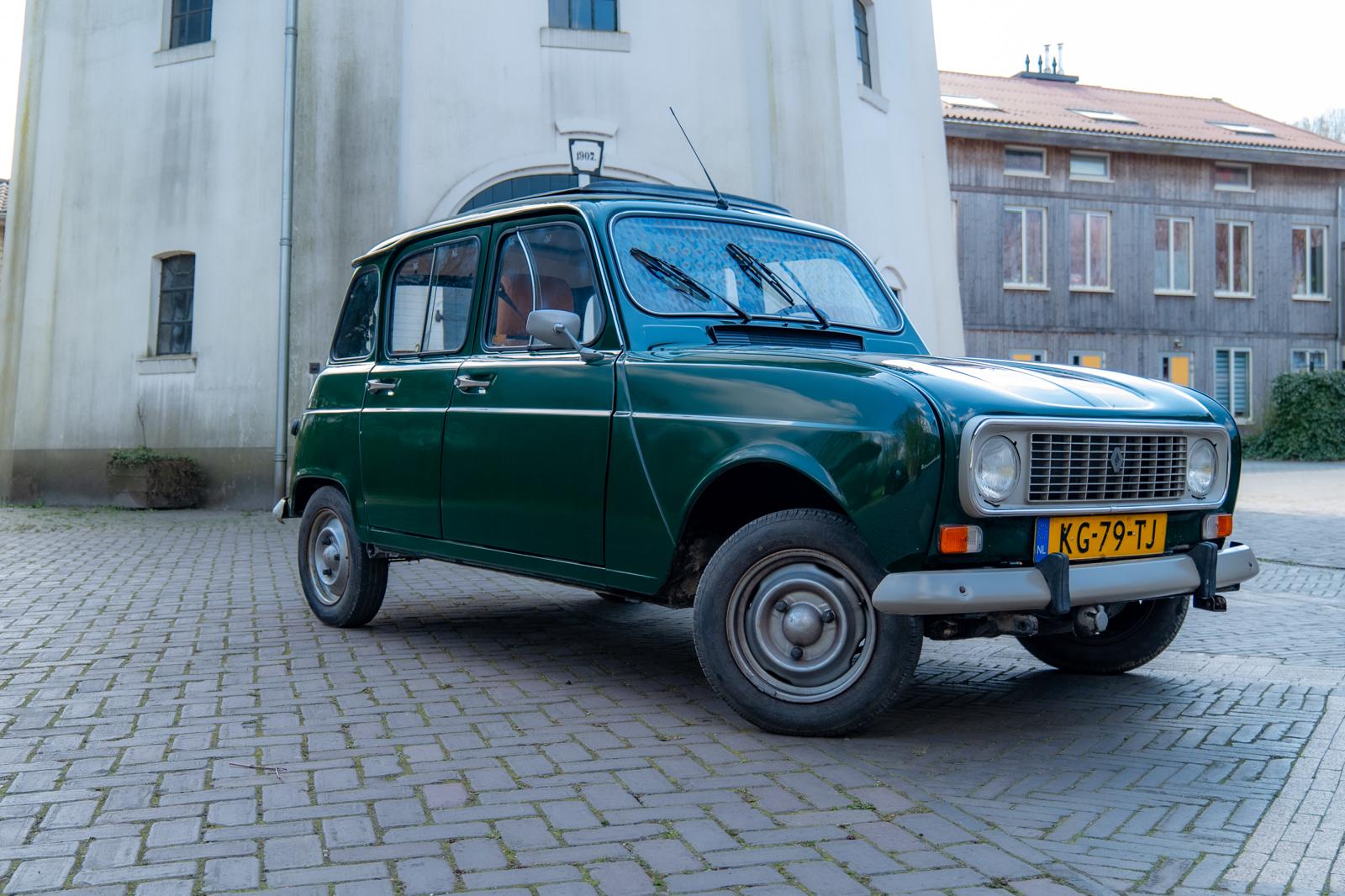
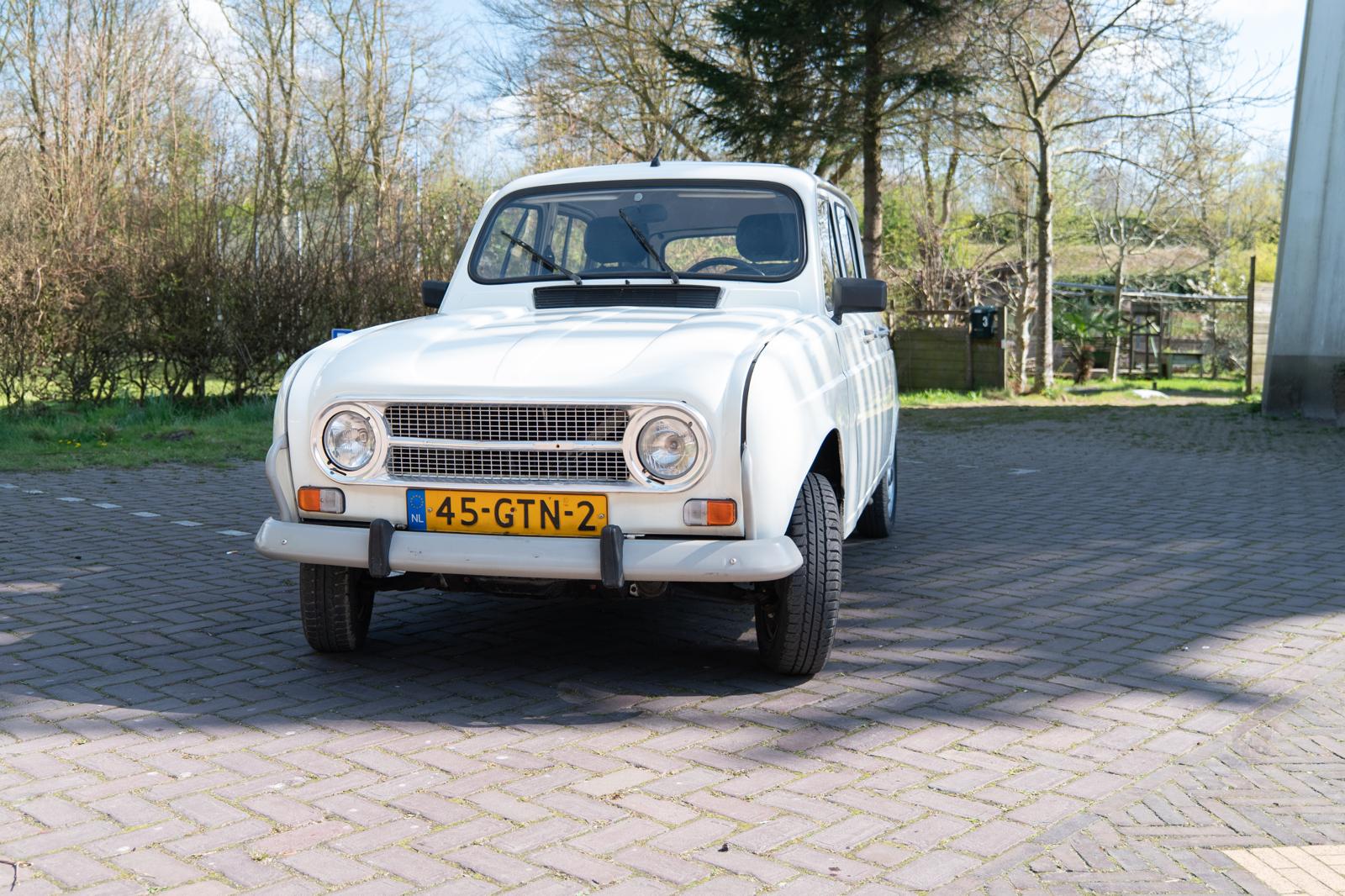
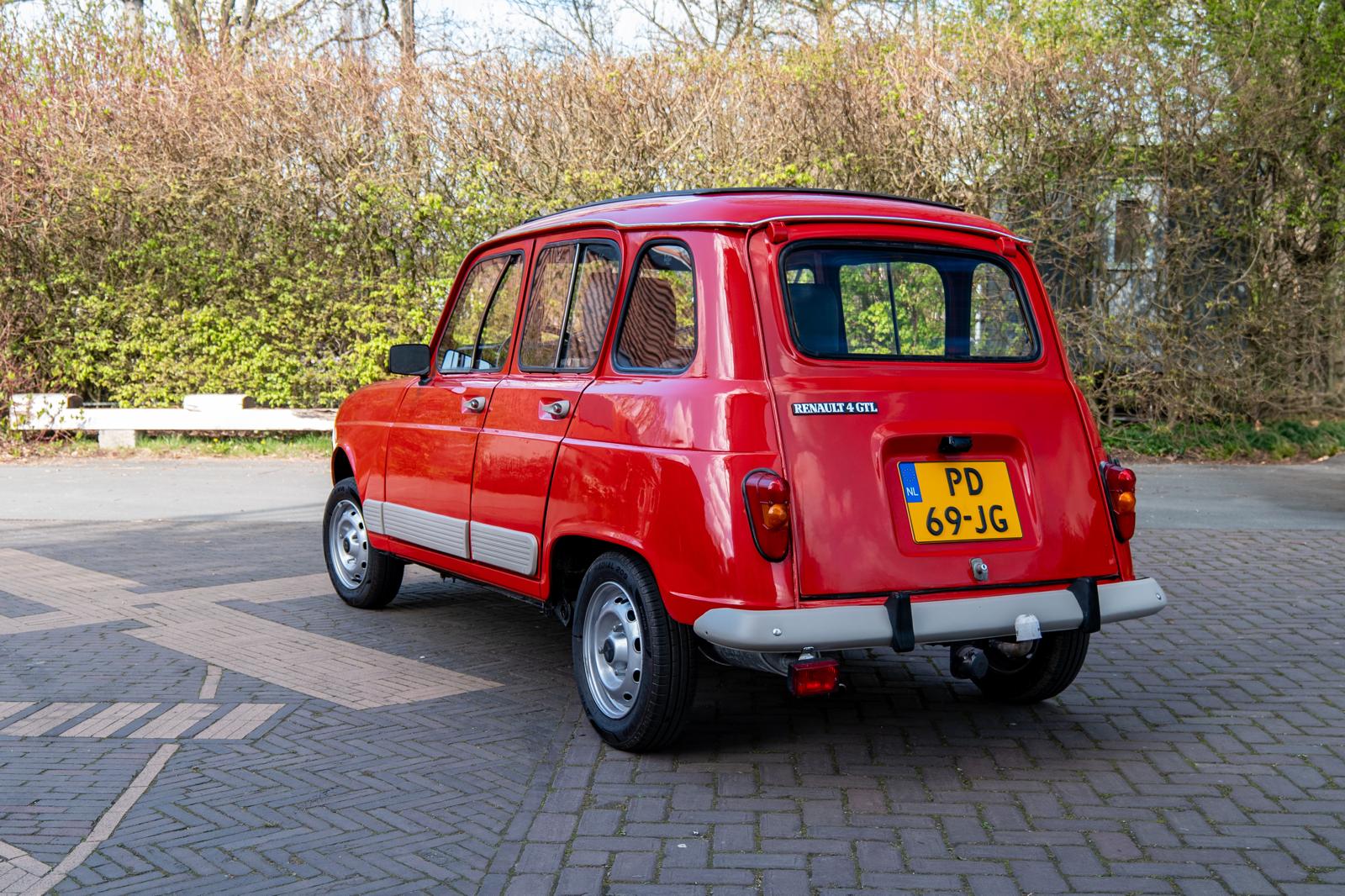
At Tonny’s Classic Drive we have three in our fleet: a Red GTL, a Green TL and a White TL. Very often, someone rents these cars for a day of touring with father and/or mother. Back in time—the best gift you can give your parents. But have you ever thought about renting the Renault 4 as a wedding car? With us you can rent beautiful wedding cars in Groningen.
Origins: Dreyfus, the 2CV and the “blue-jean car” concept (1956–1961)
In the shadow of the Citroën 2CV
After World War II, the Renault 4CV (1947–1961) was a huge success: more than 1.1 million units. Yet by the mid-1950s, managing director Pierre Dreyfus already saw that the 4CV had passed its peak. The main competitor was not the Volkswagen Beetle, but the Citroën 2CV, which had dominated the countryside since 1948. The 2CV was cheaper to buy and maintain, extremely robust, and more practical. With the rear seat folded down or removed, you could carry almost anything. Dreyfus wanted a car that could serve both city and countryside, suitable for women and men, and more modern and practical than the 2CV—without becoming much more expensive.
Project 350 and Project 112
The project began in 1956 under the internal codename “350”. Some say this referred to a target weight of 350 kg, others to a price target of about 350,000 old francs. The truth? We don’t know for sure. Later it became “Project 112”.
The “blue-jean car” philosophy
What is the “blue-jean car”? Pierre Dreyfus wanted a car that was as universal, timeless, practical, and “classless” as a pair of jeans. Everyone should be able to wear it. Or drive it. This metaphor became the core of the design process and, to this day, remains a perfect description of the Renault 4.
The revolutionary requirements
Development took five years, with countless prototypes. Dreyfus set requirements that were revolutionary for an affordable car:
- Completely flat floor (so no driveshaft tunnel)
- Large tailgate (fifth door) for maximum loading convenience
- Independent suspension with exceptionally long travel
- Very low maintenance costs (no grease points, sealed cooling system)
- Price below that of the 2CV at launch.
Renault 4 engineering explained
Front-wheel drive with a longitudinal engine layout
The Renault 4 received a longitudinal front-engine layout with front-wheel drive. The engine sits longitudinally behind the front axle, but the gearbox is positioned in front of the engine, between the engine and the radiator. This is comparable to the Citroën Traction Avant. The Renault 4 broke with Renault’s earlier tradition, with models such as the 4CV that had rear-wheel drive. Choosing front-wheel drive provided better traction on poor roads—crucial for the French countryside, and also perfect for Northern Dutch backroads near Midwolda or Slochteren.
The legendary dashboard gear lever
How does the dashboard gear lever work mechanically? Because the gearbox sits in front of the engine, the lever emerges from the dashboard. With the gearbox all the way at the front, the shift linkages run over the engine. The differential sits inside the gearbox itself. That lever became legendary (see the photo below). Not only because of its position, but also because of what people used it for. It became a handy coat hook for a lady’s handbag or for the plastic bag of Chinese takeout. People called it the “coat-hanger lever” or “umbrella lever.” Just last week, a man in his seventies came to pick up our Green TL. He got in, looked at the lever, and started laughing. “My mother always hung her bag on that,” he said. “And if we’d been to the market, the shopping bags hung there. That lever did more than just shift.” If you step into a Renault 4 for the first time, you do stare at that little lever for a second. But within five minutes you notice that shifting feels intuitive and easy. I see it every time people pick up a car from us—first that look of “how does this work?”, then the smile of “oh, this actually makes perfect sense.”
The sealed cooling system
Another important detail: the Renault 4 got a sealed cooling system. That sounds simple, but for many cars of that era it was a real innovation. It meant less maintenance, no regular topping up with water, and less risk of overheating. This was an important part of Dreyfus’ requirement that the car should be low-maintenance.
Torsion-bar suspension and an unequal wheelbase
The Renault 4 uses torsion bars for suspension, both front and rear. In the 1960s this was common but effective technology. The suspension gave the R4 a lot of travel, ideal for the French countryside with its gravel roads and rough surfaces.
A curious detail: the wheelbase of the Renault 4 is not symmetrical. On the left, the wheelbase is about 4 centimeters shorter than on the right. This happened because the transversely mounted rear torsion bars needed space, and on the left side other components were in the way. It sounds like it would affect handling, but in practice you notice nothing. It is, however, a fun conversation starter over coffee.
Models & trim levels
R4 and R4L (1961–1967): The basics
At its introduction in 1961, the Renault 4 came in two basic versions: the R3 (export/base) and the R4 (standard). Soon after, the R4L was introduced—the L stood for “Luxe.” This version had a bit more comfort, better finishing, and often optional extras such as a heating system (which in the early 1960s was not yet standard). The early series had a 603cc engine with 23 hp, later replaced by a 747cc engine. The R4L became so popular that many people simply said “4L” when talking about the car. Hence the nickname.
Technical updates (1967–1978)
In 1967, the R4 received a major facelift. The characteristic round headlights became square (although some export markets kept round lamps). The new grille was cleaner and more modern. Better seats, more sound insulation, and improved brakes were also introduced.
The GTL series (1978–1992)
The GTL, introduced in 1978, was the most powerful and most luxurious version of the Renault 4. With the 1108cc Cléon engine (34 hp), the GTL was noticeably stronger than the standard TL (747cc, roughly 26–30 hp). The GTL also received:
- Better seats with headrests
- Plastic side strips (protection against parking dings)
- Later front disc brakes (instead of drum brakes all around)
- A more modern dashboard layout
The GTL was intended for people who wanted to use the R4 on the highway as well. The TL remained a simpler, cheaper alternative—authentic and practical, but slightly less suitable for long distances. Our Red GTL at Tonny’s Classic Drive is the more comfortable choice if you want to drive a bit farther. The two TLs are ideal for those who want the pure, original R4 experience: simple, robust, and very much 1960s/1970s.
Special editions: Savane, Clan, Bye-Bye
Over its long production run, Renault released many special editions, often with striking colors, extra options, or themed styling:
- Savane (1980s): safari theme, with sand colors and an adventurous look
- Clan (1989): sportier styling, intended to appeal to younger buyers
- Bye-Bye (1992): the very last series, with nostalgic details and a “farewell theme”
These editions are now sought-after collector’s items. They are rare, and if you find one in good condition, you truly have something special.
Variants & workhorses
Fourgonnette: The Renault 4 van
The Fourgonnette was the commercial version of the Renault 4. With a fully enclosed cargo area and no rear windows, it was the delivery van for small businesses, the French postal service, and countless tradespeople. The Fourgonnette stayed in production for a long time—often longer than some passenger versions—because it was simply indestructible. Load capacity was good, access via the tailgate was perfect, and the low purchase price made it ideal for start-ups. Sadly, many of these cars disappeared due to hard use and little sentimental value. A well-restored Fourgonnette is therefore rare and valuable.
Plein Air (1968–1970 and small-scale until 1980+)
The Plein Air was an extremely rare open version of the Renault 4. Unlike a true convertible, the Plein Air had no roof—only a canvas cover you could stretch over it. It was intended for leisure use: beach drives, campsites, holiday parks.
The Plein Air was mainly built by Sinpar and ACL (not directly by Renault). Production numbers are unclear, but it remains an ultimate collector’s item. Some examples were also used as light military reconnaissance vehicles.
Global production of the Renault 4
France as the core production location
Most Renault 4s were built in Renault factories in Billancourt (later Flins) in France. But the R4 was a world car. Renault set up production units in various countries to serve local markets and avoid import duties.
Production in Spain, Slovenia, and elsewhere
- Spain (FASA-Renault): production of Renault 4s for the Spanish and Portuguese market
- Slovenia (Revoz, formerly IMV): production until 1994, making Slovenia the very last production location
- Argentina, Mexico, Colombia: various variants and versions for the South American market
- Morocco (SOMACA): local assembly and later production until 1994
Moroccan production is special, because Morocco remained a huge market for the R4. Even today you still see dozens driving around daily. The car matched local needs perfectly: cheap, robust, and easy to repair.
Paris–Dakar and the indestructible image
Participation in the Dakar Rally
The Renault 4 is not a rally car. It’s a family car. Yet the R4 has been heavily modified multiple times to drive the Paris–Dakar Rally—one of the toughest and most exhausting races in the world. Although the R4 never achieved a podium finish (those were mainly Peugeots, Mitsubishis, and later purpose-built rally trucks), the simple fact that modified R4s finished the event at all was a statement. It reinforced the image: this car cannot be broken. The participating R4s had reinforced bodies, larger fuel tanks, improved suspension, and extra skid plates. But the basic shape remained recognizable.
End of production (1986–1994)
Why did Renault 4 production stop?
By the end of the 1980s, the Renault 4 was technically completely outdated. Modern cars had:
- Crumple zones
- Airbags
- Catalytic converters (for emissions standards)
- Improved safety structures
The basic design of the R4 dated back to the late 1950s. The chassis and body could not be updated to modern standards without abandoning the entire concept. Economically, that was not feasible. Renault had more modern models by then, such as the Renault 5 and the Clio, which took over as compact people’s cars.
The last Renault 4s (Slovenia and Morocco, 1992–1994)
Official production in France ended in 1992. But in Slovenia (Revoz) and Morocco (SOMACA), production continued for a while, albeit on a very limited scale. The very last Renault 4 rolled off the line in 1994. The final examples often received special details or farewell badges (such as the “Bye-Bye” edition). For enthusiasts, these last cars are emotionally valuable: the end of an era.
Legacy: The 4L Trophy
What is the 4L Trophy?
The 4L Trophy is an annual (usually in February) humanitarian rally in which students drive old Renault 4s from France to Morocco. The goal is not racing, but delivering school supplies, sports equipment, and other necessities to schools in remote areas of Morocco. The event started in 1998 and has grown enormously ever since. Every year, hundreds of teams participate. The route runs through Spain and via a ferry to Morocco, after which teams navigate through the desert.
Why can the R4 handle this?
You might think: an old family car through the desert? But the Renault 4 is surprisingly suitable for it:
- Simple engineering that’s easy to repair
- Lightweight construction (so it won’t bog down quickly in sand)
- Robust fundamentals
- Low cost (students can afford an old R4)
Of course, the cars for the 4L Trophy are prepared: extra spare parts, reinforced mountings, better tires. But the core remains the same. And every year, dozens of R4s cross the finish line, 30+ years after their build year.
Modern rebirth: Renault 4 E-Tech Electric
Concept and production version (2025)
In 2025, Renault launched the Renault 4 E-Tech Electric—a fully electric interpretation of the original. It’s not a literal copy, but a modern hatchback that honors design elements of the classic R4:
- Square headlights (recognizable from 1970s/1980s R4s)
- Compact dimensions
- A practical approach (space, simplicity, affordability)
The E-Tech Electric is built on the same platform as the Renault 5 E-Tech, with a range of around 400 km (depending on trim level). It’s Renault’s way of carrying the R4 legacy into the electric era. Production takes place in Maubeuge (France), the same region where the original R4 was once built.
Reception and the future
The Renault 4 E-Tech has been well received by enthusiasts and the press. A Car of the Year 2026 finalist, even! The design is modern yet respectful, the technology is up to date, and the price is competitive in the segment of electric city cars. Will the new R4 reach the iconic status of the original? Only time will tell. But the fact that Renault brought this model back to life shows how much value the brand places on the Renault 4 legacy.
The Renault 4 today: driving experience and practical tips
Driving experience: Back to basics
When you get into a Renault 4, the first impression is always: simple. There’s no modern electronics, no air conditioning, no cruise control. What you do have:
- A dashboard gear lever you’ll master within a few minutes
- Light steering feel (no power steering, but the car is so light it doesn’t need it)
- Excellent outward visibility (big windows, thin pillars)
- A surprisingly spacious interior
The driving experience is direct and engaging. You feel the road surface, you hear the engine, you shift yourself. That is exactly what people look for in a classic car experience.
What you notice while driving
The GTL (with the 1108cc engine) is noticeably more powerful than the TL. For driving around town or on quiet country lanes it doesn’t matter much, but if you head toward the motorway you’ll notice the difference. The TL is relaxed up to about 80–90 km/h; the GTL can handle 100–110 km/h comfortably (although “comfortable” is relative—it’s not a modern car). The dashboard gear lever really takes a bit of getting used to at first, but it soon feels natural. First gear toward you, second away from you, third toward you, fourth away from you. Reverse often has a ring you need to lift. The pattern is logical, and within five minutes everyone shifts smoothly. The space in the Renault 4 is surprising. With the rear seat slid forward or removed entirely, you can fit a bicycle inside. Or groceries, suitcases, camping gear. The flat floor and the large tailgate make it genuinely practical. A loop through Groningen, a trip to Lauwersmeer, a drive across the Hondsrug—the Renault 4 turns it all into an experience. Not because the car is particularly fast or comfortable by modern standards, but because it takes you back to a time when driving was truly driving. That’s what we mean by “Drive the Past, Create Timeless Memories.” In a Renault 4, you don’t just drive through the landscape—you also drive through time. And the best part? You can bring your parents, your partner, your friends along on that journey.
The Renault 4 at Tonny’s Classic Drive (for those who want to experience it)
At Tonny’s Classic Drive in Groningen, three Renault 4s are ready:
- Red GTL – 1108cc engine, GTL comfort, perfect for longer drives
- Green TL – authentic R4 experience for nostalgic tours
- White TL – classic and timeless, perhaps the car your parents had
After a short explanation, you’ll step in with confidence—no classic-car experience required.
Frequently asked questions about the Renault 4
Do you have a question that isn’t answered here? Email us — we know the Renault 4 from real-world experience.
Where can I rent a Renault 4?
At Tonny’s Classic Drive in Groningen, we have a wide selection of Renault 4s. We are located at Groningerweg 40 in Groningen, and from our location you can immediately head into the beautiful Groningen landscapes with the help of our wonderful routes.
Why is it called 4L or Quatrelle?
“4L” refers to the luxury version of the Renault 4, the R4L. This name became so popular that many people started calling the entire car “4L.” “Quatrelle” is a French twist on “quatre-L” (four-L).
What makes the Renault 4 an early hatchback?
The Renault 4 had a large tailgate (fifth door) that gave access to a flat load area. This concept—a compact car with practical access to the luggage space—made it one of the first mass-produced hatchbacks.
How does that dashboard gear lever work mechanically?
By placing the gearbox in front of the engine, the shift linkages run over the engine and emerge in the dashboard. It looks strange, but it’s actually a logical consequence of the compact front-wheel-drive layout.
Why is the wheelbase unequal?
The transversely mounted rear torsion bars required space. On the left side, less space was available due to other components, which made the wheelbase about 4 cm shorter there. This had no impact on handling.
What was the difference between TL and GTL?
The GTL (1978) had a stronger 1108 cc engine (34 hp), better seats, plastic side strips, and later front disc brakes. The TL was the standard version with the 747 cc engine. The GTL was more comfortable and better suited to highways.
Why did production stop?
Modern environmental requirements (emissions standards) and safety requirements (crumple zones, airbags) made it economically unfeasible to modernize the R4. The basic design dated back to the 1950s and could no longer be updated to modern standards. Main production ended in 1992, with limited continued production in Slovenia and Morocco until 1994.
What is the 4L Trophy and why can the R4 handle it?
The 4L Trophy is an annual humanitarian rally in which students drive old Renault 4s to Morocco to deliver school supplies. The R4 can handle it thanks to its robust construction, simple engineering that’s easy to repair, and proven reliability.
How many Renault 4s are still on the road?
Exact numbers vary by country and registration practices. But it is clear that many are still driving, as shown by active clubs, events such as the 4L Trophy, and visibility in countries like France, Spain, and Morocco. The R4 remains popular with enthusiasts because it is easy to maintain.
What is the shift pattern of the Renault 4 dashboard gear lever?
The shift pattern of the dashboard gear lever is: first gear toward you (down), second away from you (up), third toward you again, fourth away from you again. Reverse often has a separate ring you need to lift. The pattern feels natural within a few minutes.
What are common points of attention on a Renault 4?
The most important points of attention when driving and maintaining a Renault 4 are:
- Rust: especially in fenders, sills, and floor pans (typical for cars from this period)
- Brakes: depending on year and version. Early cars more often have drum brakes all around; later versions and some trims got front disc brakes
- Rubber parts and electrics: wiring, connectors, charging current (alternator), starter motor, and grounds often need replacement after 30–50 years
The mechanical base is robust and easy to maintain.
About this article
This guide was compiled by Tonny’s Classic Drive, a fleet of classic rental cars in Groningen. With three Renault 4s in our collection (a GTL and two TL versions), we share daily experiences with renters who want to return to the time of the “blue jeans” of the car industry. Our knowledge comes from intensive hands-on contact with these cars, thorough preparation of our fleet, and collecting stories from customers who grew up with the Renault 4.